 |
 |
 |
 |
 |
 |
 |
 |
 |

 |
Ceramic, Heal Thyself
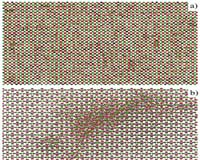
Richland WA (SPX) Apr 28, 2008 A new computer simulation has revealed a self-healing behavior in a common ceramic that may lead to development of radiation-resistant materials for nuclear power plants and waste storage. Researchers at the Department of Energy's Pacific Northwest National Laboratory found that the restless movement of oxygen atoms heals radiation-induced damage in the engineered ceramic yttria-stabilized zirconia. Scientists Ram Devanathan and Bill Weber modeled how well that ceramic and other materials stand up to radiation. "If you want a material to withstand radiation over millennia, you can't expect it to just sit there and take it. There must be a mechanism for self-healing," said Devanathan. "This research raises the possibility of engineering mobile defects in ceramics to enhance radiation tolerance," Weber said. He noted that materials capable of handling high-radiation doses also "could improve the durability of key equipment and reduce the costs of replacements." The researchers approached their investigation in three steps. First, they analyzed yttria-stabilized zirconia, a compound of yttrium and zirconium oxides that contains random structural defects called "vacancies." The defects occur because yttrium has a smaller electrical charge than zirconium. To correct the charge imbalance, zirconia gives up oxygen atoms. But the loss of these oxygen atoms leaves empty oxygen sites. The remaining oxygen atoms constantly jump in and out of those sites. "It is like a classroom full of fidgety kids," said Devanathan. "When the teacher turns her back, the kids constantly jump into empty chairs, leaving their own chairs vacant until another kid leaps into the seat." Next, the scientists simulated an atom undergoing alpha decay. An alpha particle shoots out of the atomic nucleus with such force that the remainder of the atom recoils in the opposite direction. The recoiling atom can cause significant damage to surrounding atomic structures. Finally, the researchers used data analysis algorithms developed at PNNL to look for atoms knocked out of place. The results showed that displaced oxygen atoms in the yttria-stabilized zirconia "found seats" in the pre-existing vacancies throughout the ceramic. Although the self-healing activity does not completely repair the material, the defects are less apt to cause problems because they are spread out. This characteristic indicates that yttria-stabilized zirconia, which is used today in such items as solid oxide fuel cells and oxygen sensors, might be suitable for nuclear applications. The researchers also simulated the impact of radiation on zircon, a ceramic that is a candidate for immobilizing high-level nuclear waste. The simulation defects clustered together in simulations of zircon, changing the properties of the material. "Clustered defects are much more difficult to repair than isolated defects, Devanathan said. The scientists now are refining the simulations and applying them to other materials. DOE's Office of Basic Energy Sciences funded the research, which was performed on massively parallel supercomputers in the William R. Wiley Environmental Molecular Sciences Laboratory (EMSL) at PNNL, and the National Energy Research Scientific Computer Center at Lawrence Berkeley National Laboratory. Community Email This Article Comment On This Article Related Links the missing link Civil Nuclear Energy Science, Technology and News Powering The World in the 21st Century at Energy-Daily.com
 Power company applies to build Finland's sixth nuclear reactor
 Helsinki (AFP) April 25, 2008
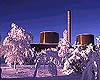
Finnish electricity producer Teollisuuden Voima (TVO) submitted on Friday an application to build a new nuclear reactor in Olkiluoto, in southwestern Finland, the ministry of employment and the economy said. |
|
|

| The content herein, unless otherwise known to be public domain, are Copyright 1995-2007 - SpaceDaily.AFP and UPI Wire Stories are copyright Agence France-Presse and United Press International. ESA Portal Reports are copyright European Space Agency. All NASA sourced material is public domain. Additional copyrights may apply in whole or part to other bona fide parties. Advertising does not imply endorsement,agreement or approval of any opinions, statements or information provided by SpaceDaily on any Web page published or hosted by SpaceDaily. Privacy Statement |