
 |
 |
 |
 |
 |
 |
 |
 |
 |

 |
Chemists Create Two-Armed Nanorobotic Device
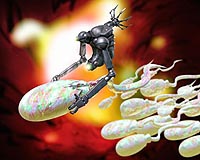
New York NY (SPX) Feb 19, 2009 Chemists at New York University and China's Nanjing University have developed a two-armed nanorobotic device that can manipulate molecules within a device built from DNA. The device is described in the latest issue of the journal Nature Nanotechnology. "The aim of nanotechnology is to put specific atomic and molecular species where we want them and when we want them there," said NYU Chemistry Professor Nadrian Seeman, one of the co-authors. "This is a programmable unit that allows researchers to capture and maneuver patterns on a scale that is unprecedented." The device is approximately 150 x 50 x 8 nanometers. A nanometer is one billionth of a meter. Put another way, if a nanometer were the size of a normal apple, measuring approximately 10 centimeters in diameter, a normal apple, enlarged proportionally, would be roughly the size of the earth. The creation enhances Seeman's earlier work-a single nanorobotic arm, completed in 2006, marking the first time scientists had been able to employ a functional nanotechnology device within a DNA array. The new, two-armed device employs DNA origami, a method unveiled in 2006 that uses a few hundred short DNA strands to direct a very long DNA strand to form structures that adopt any desired shape. These shapes, approximately 100 nanometers in diameter, are eight times larger and three times more complex than what could be created within a simple crystalline DNA array. As with Seeman's previous creation, the two-armed nanorobotic device enables the creation of new DNA structures, thereby potentially serving as a factory for assembling the building blocks of new materials. With this capability, it has the potential to develop new synthetic fibers, advance the encryption of information, and improve DNA-scaffolded computer assembly. In the two-armed nanorobotic device, the arms face each other, ready to capture molecules that make up a DNA sequence. Using set strands that bind to its molecules, the arms are then able to change the structure of the device. This changes the sticky ends available to capture a new pattern component. The researchers note that the device performs with 100 percent accuracy. Earlier trials revealed that it captured targeted molecules only 60 to 80 percent of the time. But by heating the device in the presence of the correct species, they found that the arms captured the targeted molecules 100 percent of the time. They confirmed their results by atomic force microscopy (AFM), which permits features that are a few billionths of a meter to be visualized. Share This Article With Planet Earth
Related Links New York University Nano Technology News From SpaceMart.com Computer Chip Architecture, Technology and Manufacture
 Nanoparticle Toxicity Doesn't Get Wacky At The Smallest Sizes
 Chicago IL (SPX) Feb 18, 2009
The smallest nano-sized silica particles used in biomedicine and engineering likely won't cause unexpected biological responses due to their size. The result should allay fears that cells and tissues will react unpredictably when exposed to the finest silica nanomaterials in industrial or commercial applications. |
|
|

| The content herein, unless otherwise known to be public domain, are Copyright 1995-2007 - SpaceDaily.AFP and UPI Wire Stories are copyright Agence France-Presse and United Press International. ESA Portal Reports are copyright European Space Agency. All NASA sourced material is public domain. Additional copyrights may apply in whole or part to other bona fide parties. Advertising does not imply endorsement,agreement or approval of any opinions, statements or information provided by SpaceDaily on any Web page published or hosted by SpaceDaily. Privacy Statement |
 del.icio.us
 Digg
Digg Reddit
 YahooMyWeb
 Google
 Facebook