
 |
 |
 |
 |
 |
 |
 |
 |
 |

 |
Eight Teams Taking Up ESA's Lunar Robotics Challenge
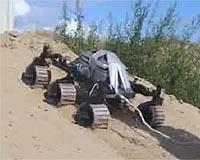
Paris, France (ESA) Jul 03, 2008 As interest in exploration of the Moon soars among the world's space agencies, ESA, through it's General Studies Programme, has challenged university students to develop a robotic vehicle that is capable of working in difficult terrain, comparable to that found at the lunar poles. Eight university teams have been selected to proceed to the design stage of ESA's Lunar Robotics Challenge. ESA's first Lunar Robotics Challenge got under way in late March with the issuing of an Announcement of Opportunity that invited teams of university students to create an innovative, mobile robot capable of retrieving samples from a lunar-like crater. Eight of the submitted proposals have been selected for funding after evaluation by a team of ESA experts. The selected student teams received the go-ahead to design their robotic systems, and eventually build them to compete in the challenge event.
Challenge objectives The robot's test mission includes a number of objectives: - move from a 'landing site' to the rim of a lunar-like crater - descend into the crater, negotiating an incline of up to 40 degrees - operate in sunlight on the crater rim, and in the dark interior of the crater - reach the bottom of the 15 m deep crater - locate and retrieve at least 0.1 kg of selected, visually distinctive, soil samples from the bottom of the crater - return to the crater rim and then the 'landing site' - The vehicle will be remotely operated by a workstation placed outside the crater and with no direct visibility of the crater or rim. Selected teams The teams selected to proceed with the design phase, supported by funding from the ESA General Studies Programme (GSP), are: - Universit�t Bremen, Germany, - Jacobs University Bremen, Germany, - Universidad Politecnica de Madrid, Spain, - Oulun Yliopisto (University of Oulu), Finland - Universit� di Pisa, Italy, - Scuola Superiore Sant'Anna Pisa, Italy, - Surrey Space Centre, University of Surrey, United - Swiss Federal Institute of Technology (Eidgenossische Technische Hochschule - ETH) Zurich, Switzerland Each team is required to maintain a web blog during the challenge.
Reviews and competition If they are successful at the CDR, the teams will be given approval and further funding to build their entry. A Test Readiness Review will be held at the premises of each university team once construction of their robot is complete. The challenge will culminate in a 10-day competition, to be held in October 2008. Community Email This Article Comment On This Article Share This Article With Planet Earth
Related Links Automation and Robotics All about the robots on Earth and beyond!
 Three Engineers, Hundreds of Robots, One Warehouse
 New York NY (SPX) Jun 25, 2008
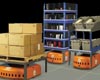
Two dozen squat robots scurry on the warehouse floor. They park underneath man-high inventory racks and activate a lifting mechanism that jacks the racks off the ground. One robot hauls shelves with 12-packs of Mountain Dew; another carries bottles of Redken shampoo. |
|
|

| The content herein, unless otherwise known to be public domain, are Copyright 1995-2007 - SpaceDaily.AFP and UPI Wire Stories are copyright Agence France-Presse and United Press International. ESA Portal Reports are copyright European Space Agency. All NASA sourced material is public domain. Additional copyrights may apply in whole or part to other bona fide parties. Advertising does not imply endorsement,agreement or approval of any opinions, statements or information provided by SpaceDaily on any Web page published or hosted by SpaceDaily. Privacy Statement |
 del.icio.us
 Digg
Digg Reddit
 YahooMyWeb
 Google
 Facebook