
 |
 |
 |
 |
 |
 |
 |
 |
 |

 |
European freighter detaches from space station
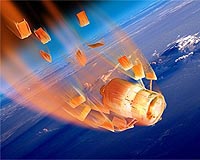
Paris (AFP) Sept 6, 2008 A European robot freighter decoupled from the International Space Station (ISS), positioning itself for a fiery, suicide descent into Earth's atmosphere. The Automated Trasfer Vehicle (ATV) is expected to burn up in the upper atmosphere over a "completely uninhabited" area of the Pacific on September 29, the European Space Agency (ESA) said. The ATV left the space station at 2129 GMT Friday, the ESA said, having taken 7.5 tonnes of equipment, water and air to the ISS crew on its maiden flight in April. It has been used as a temporary leisure centre and sleeping area over the past five months. The freighter brought back several tonnes of refuse from the ISS. Its engines were to use some of the remaining fuel to park the 13.5-tonne craft in a new orbit over the following three weeks. Tethered to the ISS, the ATV carried out four operations to boost the station to a safe height of 355 kilometres (221 miles) in order to overcome residual atmospheric drag. On August 27, it was also used to steer the ISS out of the path of potentially dangerous orbiting debris. The first ATV -- named after the 19th-century French sci-fi pioneer Jules Verne -- was hugely esteemed by the ISS's three crew, Sergei Volkov, Oleg Kononenko and Greg Chamitoff, ESA said. "It became one of the best places for the crew to live," said French astronaut Jean-Francois Clervoy, who advised ESA on how the freighter could be turned to human use. "Even though our schedule has been very busy at the ATV Control Centre, I couldn't have wished for a better mission," said Herve Come, ESA's ATV lead mission director. Jules Verne's programmed destruction will take place at night so that scientists can gain an insight into how large objects behave when they return to Earth. NASA is deploying two aircraft laden with radar, ultra-violet and other sensors to monitor the burnup. The Jules Verne measures 10 metres (32.5 feet) in length, offering 50 cubic metres (1,765 cu. feet), or nearly the capacity of a large shipping container. Designed and built for 1.3 billion euros (1.885 billion dollars), the craft is Europe's costliest contribution to the ISS. It will be followed by four more cargo ships, whose assembly and launch will each cost over 300 million euros (435 million dollars). Community Email This Article Comment On This Article Share This Article With Planet Earth
Related Links Station at NASA Station and More at Roscosmos S.P. Korolev RSC Energia Watch NASA TV via Space.TV Space Station News at Space-Travel.Com
 NASA TV to show ISS cargo ship arrival
 Houston (UPI) Sep 4, 2008
 An unpiloted Russian resupply spacecraft will arrive at the International Space Station next week and the U.S. space agency plans to televise the event live. |
|
|

| The content herein, unless otherwise known to be public domain, are Copyright 1995-2007 - SpaceDaily.AFP and UPI Wire Stories are copyright Agence France-Presse and United Press International. ESA Portal Reports are copyright European Space Agency. All NASA sourced material is public domain. Additional copyrights may apply in whole or part to other bona fide parties. Advertising does not imply endorsement,agreement or approval of any opinions, statements or information provided by SpaceDaily on any Web page published or hosted by SpaceDaily. Privacy Statement |
 del.icio.us
 Digg
Digg Reddit
 YahooMyWeb
 Google
 Facebook