
 |
 |
 |
 |
 |
 |
 |
 |
 |

 |
GD Delivers First USV To US Navy For LCS
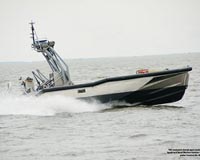
Westminster MD (SPX) May 21, 2008 General Dynamics Robotic Systems delivered the first 11-meter "Fleet" class Anti-Submarine Warfare Unmanned Surface Vehicle (ASW USV) to the U.S. Navy on May 2 as part of the Littoral Combat Ship (LCS) mission package. General Dynamics Robotic Systems is a part of General Dynamics Land Systems (Sterling Heights, Michigan), a business unit of General Dynamics. General Dynamics has worked in partnership with a Navy team that includes PEO-Littoral and Mine Warfare (LMW), PMS-420 LCS Mission Package Systems, Space and Naval Warfare Systems Center, San Diego (SSC San Diego) and the Naval Undersea Warfare Center (NUWC) to design, integrate, test and deliver the USV. A second USV will be delivered to Naval Undersea Warfare Center in Newport, Rhode Island, in June. These USVs are the first unmanned surface vehicles to ever receive hull numbers from the Navy, and will be known as "11MUC0601" and "11MUC0602," respectively. LCS is a fast, agile, focused-mission platform designed for operation in near-shore environments to defeat asymmetric "anti-access" threats such as mines, quiet diesel submarines and fast surface craft. The ASW USV operates and supports payloads and sensor systems, including an unmanned towed-array sonar system and an active multi-static offboard low-frequency sonar system. The General Dynamics-designed vehicle provides a high-speed, high-payload capable craft with excellent sea keeping characteristics, along with a state-of-the-art unmanned navigation and autonomous control capability that includes 360-degree situational awareness. The USV has a payload capacity of 5,000 pounds, beam length of 11.2 feet and is capable of operating continuously for 24 hours or more. During high-speed transits the vehicle can reach speed of 35 knots or higher. A government-developed bow latch will launch and recover the unmanned surface vehicle from the LCS. As a semi-autonomous vehicle, the USV is capable of way-point navigation, sea keeping and station keeping. Community Email This Article Comment On This Article Share This Article With Planet Earth
Related Links UAV News - Suppliers and Technology
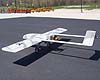
 AAI's Shadow UAS Reach 300,000 Flight Hours
 Hunt Valley MD (SPX) May 21, 2008
AAI has announced that its Shadow UAS have achieved 300,000 cumulative flight hours in service with the U.S. Army and Marine Corps. In fact, 91 percent of these flight hours were amassed in support of Operation Iraqi Freedom and Operation Enduring Freedom. |
|
|

| The content herein, unless otherwise known to be public domain, are Copyright 1995-2007 - SpaceDaily.AFP and UPI Wire Stories are copyright Agence France-Presse and United Press International. ESA Portal Reports are copyright European Space Agency. All NASA sourced material is public domain. Additional copyrights may apply in whole or part to other bona fide parties. Advertising does not imply endorsement,agreement or approval of any opinions, statements or information provided by SpaceDaily on any Web page published or hosted by SpaceDaily. Privacy Statement |
 del.icio.us
 Digg
Digg Reddit
 YahooMyWeb
 Google
 Facebook