 |
 |
 |
 |
 |
 |
 |
 |
 |

 |
Global warming could invite sharks to Antarctica: biologists
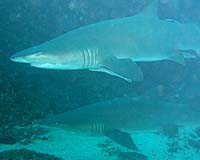
Boston, Massachusetts (AFP) Feb 15, 2008 Global warming could bring ferocious sharks to Antarctic waters, threatening a unique marine life shielded from predators by frigid conditions for millions of years, biologists warn. Biologists gathered here for the annual conference of the American Association for the Advancement of Science warned that the return of predators to Antarctica could prove devastating to its underwater ecosystem. Antarctica's surrounding waters remain too cold for sharks and other fish capable of crushing shellfish similar to the mollusks living in the vast continent's seas, said University of Rhode Island biology professor Cheryl Wilga. "As a result, the Antarctic seafloor has been dominated by relatively soft-bodied, slow-moving invertebrates, just as in ancient oceans prior to the evolution of shell-crushing predators," she told a news conference Friday on the sidelines of the conference. But global warming has already pushed temperatures up by one to two degrees in the past 50 years, and the waters could become hospitable to sharks within the next 100 years, she said. "The water only needs to remain above freezing year round for it to become habitable to some sharks, and at the rate we're going, that could happen this century," Wilga said. "Once they get there, it will completely change the ecology of the Antarctic benthic community," she said. While sharks may one day roam Antarctic waters, crabs are already crawling closer to the vast continent for the first time in ages, adding one more worry for a marine life left intact since the Paleozoic area of 250 million to 500 million years ago, biologists said. "Predatory crabs are poised to return to warming Antarctic waters for the first time in millions of years, which will disrupt the composition of the archaic marine communities," Rick Aronson, of the Dauphin Island Sea Lab in Alabama, told the news conference. "Shallow-water, benthic communities in Antarctica are unique," he said. "Nowhere else do giant pycnogonids, nemerteans and isopods occur in shallow marine environments, cohabiting with fish that have anti-freeze glycoproteins in their blood." Sven Thatje of National Oceanography Center in Southampton, Britain, urged the international community to take action to curb greenhouse gases that cause global warming and prevent an ecological disaster. "The crabs are on the doorsteps, they are sitting in deep water, and only a couple of hundred bathymetric meters now separate them from the slightly cooler shallow water in Antarctic shelf environment," he said. The oceanographer made the crab discovery with other British journalists in January 2007. He warned that the return of shell-cracking predators to Antarctica "would be a tragic loss for biodiversity in one of the last wild places on Earth." Community Email This Article Comment On This Article Related Links Beyond the Ice Age
 Antarctic Ice Loss Speeds Up, Nearly Matches Greenland Loss
 Pasadena CA (SPX) Jan 24, 2008
Ice loss in Antarctica increased by 75 percent in the last 10 years due to a speed-up in the flow of its glaciers and is now nearly as great as that observed in Greenland, according to a new, comprehensive study by NASA and university scientists. In a first-of-its-kind study, an international team led by Eric Rignot of NASA's Jet Propulsion Laboratory, Pasadena, Calif., and the University of California, Irvine, estimated changes in Antarctica's ice mass between 1996 and 2006 and mapped patterns of ice loss on a glacier-by-glacier basis. |
|
|

| The content herein, unless otherwise known to be public domain, are Copyright 1995-2007 - SpaceDaily.AFP and UPI Wire Stories are copyright Agence France-Presse and United Press International. ESA Portal Reports are copyright European Space Agency. All NASA sourced material is public domain. Additional copyrights may apply in whole or part to other bona fide parties. Advertising does not imply endorsement,agreement or approval of any opinions, statements or information provided by SpaceDaily on any Web page published or hosted by SpaceDaily. Privacy Statement |