 |
 |
 |
 |
 |
 |
 |
 |
 |

 |
HiRISE Camera Views Spirit At Home Plate
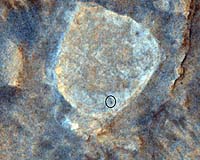
Pasadena CA (SPX) Nov 28, 2007 The High Resolution Imaging Science Experiment, or HiRISE, camera onboard NASA's Mars Reconnaissance Orbiter has taken a new color image of the feature dubbed "Home Plate" in Gusev Crater on Mars. The Mars Exploration Rover "Spirit" shows up inside the perimeter of Home Plate, where it was when HiRISE took the image on Sept. 27, 2007, at 2:19 pm local Mars time, HiRISE team member Ken Herkenhoff of the U.S. Geological Survey, Flagstaff, said. Spirit is driving toward the safe, north-facing slopes on the north side of Home Plate, which is toward the top of the image. There it will be positioned to tilt its solar panels toward the sun for the long Martian winter. Home Plate is a flat, raised feature that is probably a remnant of a deposit emplaced by an ancient eruption, Herkenhoff added. The new color image of Home Plate was created using the camera's blue-green and red channels, Herkenhoff said. At the time, the camera was flying about 270 kilometers, or about 168 miles, over the surface. At that distance, the camera could resolve objects about 81 centimeters, or about 32 inches, across. The sun was about 56 degrees above the horizon in the winter afternoon sky. The HiRISE image of Home Plate and others are on the HiRISE Website, http://hirise.lpl.arizona.edu. HiRISE operations are based at The University of Arizona in Tucson. Professor Alfred S. McEwen of the Lunar and Planetary Laboratory is principal investigator for the experiment. The HiRISE camera is the most powerful camera ever to orbit another planet. It has taken thousands of black-and-white images, and hundreds of color images, since it began science operations in 2006. A single HiRISE image will often be a multigigabyte image that measures 20,000 pixels by 50,000 pixels, which includes a 4,000-by-50,000 pixel region in three colors. It can take a computer up to three hours to process such an image. Community Email This Article Comment On This Article Related Links Mars Reconnaissance Orbiter Mars News and Information at MarsDaily.com Lunar Dreams and more
 Opportunity Peers Beneath Surface Of Bathtub Ring
 Pasadena CA (SPX) Nov 26, 2007
Opportunity remains parked at the rock layer known as "Smith" -- part of the "bathtub ring" of rock layers beneath the edge of "Victoria Crater - - at "Duck Bay," the alcove where the rover entered the crater. During a test of the wire brush on the rock abrasion tool in a new mode of operation developed to work around recent encoder failures, Opportunity was mistakenly commanded to rotate the brush in the wrong direction. |
|
|

| The content herein, unless otherwise known to be public domain, are Copyright 1995-2006 - SpaceDaily.AFP and UPI Wire Stories are copyright Agence France-Presse and United Press International. ESA PortalReports are copyright European Space Agency. All NASA sourced material is public domain. Additionalcopyrights may apply in whole or part to other bona fide parties. Advertising does not imply endorsement,agreement or approval of any opinions, statements or information provided by SpaceDaily on any Web page published or hosted by SpaceDaily. Privacy Statement |