
 |
 |
 |
 |
 |
 |
 |
 |
 |

 |
NASA's Phoenix Mars Lander Delivers Soil Sample To Microscope
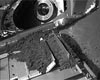
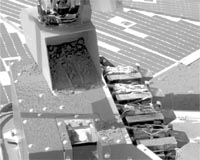
Tucson AZ (SPX) Jun 13, 2008 NASA's Phoenix Mars Lander sprinkled a spoonful of Martian soil Wednesday onto the sample wheel of the spacecraft's robotic microscope station, images received early Thursday confirmed. "It looks like a light dusting and that's just what we wanted. The Robotic Arm team did a great job," said Michael Hecht of NASA's Jet Propulsion Laboratory, Pasadena, Calif. He is the lead scientist for the Microscopy, Electrochemistry and Conductivity Analyzer (MECA) instrument on Phoenix. The delivery of scooped-up soil for inspection by the lander's Optical Microscope, a component of MECA, marks the second success in consecutive days for getting samples delivered to laboratory instruments on Phoenix's deck. Some soil from an earlier scoopful reached a tiny oven in another instrument on Tuesday, as confirmed in data received early Wednesday. That instrument is the Thermal and Evolved-Gas Analyzer, or TEGA. Commands being sent to Phoenix today include instructions to close TEGA oven number 4 and begin analyzing the sample inside, a process that will take several days. The soil now in the microscope station came from the same scoopful that was used for a practice run of the sprinkle delivery technique on Monday. That scoopful has the informal name "Mama Bear." The sample delivered to TEGA oven 4 has the informal name "Baby Bear." Both came from a trench now called "Goldilocks" but earlier referred to as Baby Bear, on the northwest side of the lander. The Phoenix team assembled at the University of Arizona plans to command the Robotic Arm in the next day or two to dig deeper into the Goldilocks trench and an adjacent trench called "Dodo" to determine the depth to an underlying layer of hard material that may be ice. Community Email This Article Comment On This Article Share This Article With Planet Earth
Related Links the missing link Mars News and Information at MarsDaily.com Lunar Dreams and more
 After whole lotta shakin', Mars probe ready to bake
 Washington (AFP) June 11, 2008
Scientists were all smiles Wednesday after samples of Martian arctic soil finally dropped into the Phoenix lander's oven instrument, putting the search for signs of past life on Mars back on track. |
|
|

| The content herein, unless otherwise known to be public domain, are Copyright 1995-2007 - SpaceDaily.AFP and UPI Wire Stories are copyright Agence France-Presse and United Press International. ESA Portal Reports are copyright European Space Agency. All NASA sourced material is public domain. Additional copyrights may apply in whole or part to other bona fide parties. Advertising does not imply endorsement,agreement or approval of any opinions, statements or information provided by SpaceDaily on any Web page published or hosted by SpaceDaily. Privacy Statement |
 del.icio.us
 Digg
Digg Reddit
 YahooMyWeb
 Google
 Facebook