
 |
 |
 |
 |
 |
 |
 |
 |
 |

 |
Nissan uses bumblebee power in new car technology
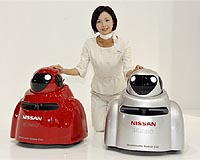
Makuhari, Japan (AFP) Sept 30, 2008 Japan's Nissan Motor Co. has tapped into an unlikely source of inspiration for technology to prevent car crashes -- bumblebees. The Biomimetic Car Robot Drive, or BR23C, is a metre-high duckling-shaped robot with a sensor that recreates the highly complex eyes of a bumblebee. The robot can detect an object up to two metres (2.2 yards) away in a 180-degree radius. It swerves away on wheels when a person or an object suddenly appears in front of it. While the robot now looks like a toy -- its eyes light up and turn red or blue when it spots an obstacle -- Nissan hopes eventually to put the technology into cars. "The split second it detects an obstacle, it will instantly change direction by turning its wheels to a right angle or further to avoid collision," said Toshiyuki Ando, a Nissan engineer who led research efforts. "The whole process must mirror what a bee does to avoid other bees. It must happen with the blink of an eye," he said. Japan's third largest automaker teamed up with researchers from the University of Tokyo to develop part of the system, which calculates the distance to an object and then sends the information back into the car. The robot was showcased at the CEATEC, or Cutting-edge IT Comprehensive Exhibition, which opened Tuesday outside Tokyo for a week-long run bringing together 804 electronics companies showing their goods. Nissan hopes to install the technology in its electric vehicles -- such as the Pivo 2 which has wheels that turn 90 degrees -- as it tries to become a leader in next-generation eco-friendly vehicles. "Electric vehicles have wheels that can move at various angles and so with this technology installed, the possibility of quickly escaping a crash or avoiding an obstacle increases," Ando said. Nissan aims to start selling an electric car in the United States and Japan in 2010 and the rest of the world in 2012. Community Email This Article Comment On This Article Share This Article With Planet Earth
Related Links Car Technology at SpaceMart.com
 Reducing Work Commutes Not Easy In Some Cities
 Columbus, OH (SPX) Sep 30, 2008
Shorter work commutes are one way to reduce gasoline consumption, but a new study finds that not all cities are equal in how easy it would be to achieve that goal. Research suggests that Atlanta and Minneapolis may be the U.S. metropolitan areas that would find it most difficult to reduce the miles that workers commute each day. |
|
|

| The content herein, unless otherwise known to be public domain, are Copyright 1995-2007 - SpaceDaily.AFP and UPI Wire Stories are copyright Agence France-Presse and United Press International. ESA Portal Reports are copyright European Space Agency. All NASA sourced material is public domain. Additional copyrights may apply in whole or part to other bona fide parties. Advertising does not imply endorsement,agreement or approval of any opinions, statements or information provided by SpaceDaily on any Web page published or hosted by SpaceDaily. Privacy Statement |
 del.icio.us
 Digg
Digg Reddit
 YahooMyWeb
 Google
 Facebook