
 |
 |
 |
 |
 |
 |
 |
 |
 |

 |
Robo-Surgery: Safe And Capable In Key-Hole Gallbladder Removal
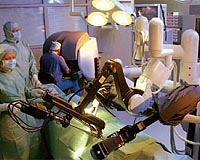
London, UK (SPX) Jan 26, 2009 Using a robotic assistant to remove a patient's gallbladder by key-hole surgery (laparoscopic cholecystectomy) is as safe as working with a human assistant, a Cochrane Review has concluded. Comparisons between robot- and human-assisted surgery showed that there were no differences in terms of morbidity, the need to switch to open surgery, total operating time, or length of stay in hospital. Between 10 and 15% of the adult western population develop gallstones, placing a huge demand on health services. In the USA alone, more than 500,000 people have their gall bladder removed each year. The preferred way of doing this is now to use keyhole surgery that involves a surgeon and an assistant. In key-hole surgery, the surgeon sees inside the patient via a long camera introduced through a 1 cm abdominal cut. The camera guides the surgeon in using the surgical instruments introduced through other small cuts (ranging from 0.5 to 1 cm). The assistant's job is to move the camera, which acts as the surgeon's eyes. A range of robots can now perform this task: this study looked at trials involving 'Endoassist', 'Aesop', 'Passist' and 'Zeus'. To assess how well robots were performing, a team of researchers considered data from five randomised trials that included a total of 453 patients. The results showed a marginal (though not statistical) decrease in the numbers of gallbladders that burst during robot-assisted surgery, but overall there was no appreciable difference. "We need more trials that see whether the success rates using robotic assistants increase once surgeons have more experience using them," said lead researcher Kurinchi Gurusamy, who works at the University Department of Surgery at the Royal Free Hospital, London. One of the aims behind using robots is that it could enable a surgeon to perform an emergency operation without having to wait for a human assistant to become available. This could have distinct advantages in countries where there are limits to the numbers of hours assistants are allowed to work. Current data suggest that we are not yet at that point. "Robotic assistants seem to be an exciting possibility, but we are not yet at the stage that they should be used as replacements for human assistants," says Gurusamy. Share This Article With Planet Earth
Related Links Royal Free Hospital Hospital and Medical News at InternDaily.com
 Microbot Motors Fit To Swim Human Arteries
 Melbourne, Australia (SPX) Jan 23, 2009
A range of complex surgical operations necessary to treat stroke victims, confront hardened arteries or address blockages in the bloodstream are about to be made safer as researchers from the Micro/Nanophysics Research Laboratory at Australia's Monash University put the final touches to the design of micro-motors small enough to be injected into the human bloodstream. |
|
|

| The content herein, unless otherwise known to be public domain, are Copyright 1995-2007 - SpaceDaily.AFP and UPI Wire Stories are copyright Agence France-Presse and United Press International. ESA Portal Reports are copyright European Space Agency. All NASA sourced material is public domain. Additional copyrights may apply in whole or part to other bona fide parties. Advertising does not imply endorsement,agreement or approval of any opinions, statements or information provided by SpaceDaily on any Web page published or hosted by SpaceDaily. Privacy Statement |
 del.icio.us
 Digg
Digg Reddit
 YahooMyWeb
 Google
 Facebook