 |
 |
 |
 |
 |
 |
 |
 |
 |

 |
Robot anaesthetist developed in France: doctor
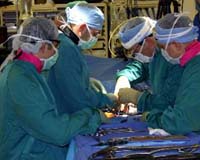
Paris (AFP) April 12, 2008 A prototype robot that can induce a general anaesthetic for operations has been developed in France using American equipment and tested on some 200 patients,the project team leader has announced. "The automatic pilot system relieves the anaesthetist of one of his tasks so that he can devote himself to the extremely important job of monitoring the patient's state," said Professor Marc Fischler, head of anaesthetics of the Foch Hospital in Suresnes, who developed the system with two other specialists. The anaesthetist's task would otherwise include administering anaesthetic drugs and pain-killers, as well as overseeing the patient's condition during the course of the operation. The French system has been tested on more than 200 patients in 10 French hospitals, as well as one in Belgium and one in Germany. "We have been fine-tuning our version for the last four years," said Fischler, speaking Friday. "In the short term it's still a research tool, but I can imagine that in the longer term it will become an instrument in everyday use," he commented. "We didn't actually invent the system, but we developed it further and we're still the only team in the world so far to have actually induced a general anaesthetic by means of the system, as well as using it during the operation," he added. "Furthermore, we can handle patients regardless of how serious their condition and even for long operations (up to 14 hours)," said Fischler. "Our added value is the software." The system includes a bispectral monitor developed in the United States some years ago which can analyse the depth of the anaesthetic by recording brain activity. An electrode on the patient's brow enables the monitor to situate the depth of anaesthesia somewhere between zero and 100, depending on the bispectral index. Data is fed into a computer which controls the supply of morphine and hypnotising drugs, with the entire process constantly monitored by anaesthetists. The bispectral index (BIS) can calculate the patient's brain state and signal any major malaise occurring. A bispectral index is a neurophysiological monitoring device which continually analyses a patient's electroencephalograms during general anaesthesia to assess the level of consciousness. Community Email This Article Comment On This Article Related Links All about the robots on Earth and beyond!
 The Future Of Robotic Warfare Part Two
 Moscow, April 11, 2008
 There will come a time when robots will become the best value for the money for the conduct of tactical operations in war. |
|
|

| The content herein, unless otherwise known to be public domain, are Copyright 1995-2007 - SpaceDaily.AFP and UPI Wire Stories are copyright Agence France-Presse and United Press International. ESA Portal Reports are copyright European Space Agency. All NASA sourced material is public domain. Additional copyrights may apply in whole or part to other bona fide parties. Advertising does not imply endorsement,agreement or approval of any opinions, statements or information provided by SpaceDaily on any Web page published or hosted by SpaceDaily. Privacy Statement |