
 |
 |
 |
 |
 |
 |
 |
 |
 |

 |
Space station gets big Japanese lab room
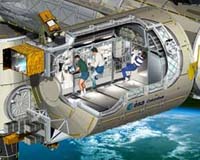
Washington (AFP) June 3, 2008 Astronauts have attached a bus-sized Japanese laboratory to the International Space Station, giving the orbiting outpost its biggest room and providing Japan with a key foothold in space. JapaneseastronautAkihikoHoshide and American colleague Karen Nyberg used the station's robotic arm to slowly pull the 15-tonne lab out of the cargo bay of shuttle Discovery, which docked on Monday, and attach it to its new home. "Congratulations, we have a new Hope on the International Space Station," Hoshide said after the lab was hooked to the ISS on Tuesday. Dubbed Kibo ("hope" in Japanese), Japan's first manned space facility is 11.2-meters (36.7-feet) long and has room for four astronauts. NASA's Destiny module is 8.5 meters long while Europe's Columbus facility measures 6.8 meters. The astronauts are scheduled to activate the cylindrical Japanese Pressurized Module (JPM) on Wednesday and enter the lab for the first time at around 2052 GMT. Kibo's 10-meter (33-foot) robotic arm, which will manipulate materials and equipment for science experiments, will also be installed during the Discovery mission. Shuttle Endeavour already brought one piece of the laboratory in March -- a logistics module that will be used for storage. The third and final part of the lab -- an outdoor facility that will allow experiments to be exposed to the effects of space -- will be delivered next year. When completed, Kibo will allow astronauts to carry out experiments in space medicine, biology and biotechnology, material production, and communications, both in a pressurized environment and completely exposed to space. The facility will be jointly monitored from the Japan Aerospace Exploration Agency's Tsukuba facility and NASA Mission Control in Houston, Texas. "We are extremely happy to see the Kibo pressurized module attached at her permanent location," Tetsuro Yokoyama, deputy Kibo operations project manager, told reporters at a briefing at NASA's Johnson Space Center in Houston. The US space agency, which hopes to complete construction of the ISS in 2010, considers the station a central part of space exploration ambitions, allowing scientists to study the effects of microgravity on humans. "It was an amazing day for the ISS program," station deputy program manager Kirk Shireman told reporters. "We're very pleased to have the pressurized module of Kibo on board the International Space Station to its final home," he said. "We're well on our way to completing the ISS." The Japanese module was installed after US astronauts MikeFossumandRonGaran removed its restraints inside the shuttle cargo bay during a six-hour, 48-minute spacewalk, about 338 kilometers (210 miles) above Earth. The spacewalkers' first order of business was to disconnect a shuttle inspection boom from the station, where it had been left behind during the last mission in March to make room for the Kibo lab inside Discovery's cargo bay. Hoshide then used the station's robotic arm to hand over the boom to Nyberg, who used the shuttle's robotic arm to return it to Discovery. The spacewalk began almost one hour late, but Fossum and Garan made up for the lost time. "Fantastic work by both of them," a NASA mission control official radioed Discovery pilot Kenneth Ham, who was choreographing the sortie, about three hours into the spacewalk. Discovery arrived at the station Monday with seven astronauts on board, joining the ISS's three-man crew for a nine-day stay. Community Email This Article Comment On This Article Share This Article With Planet Earth
Related Links Space Tourism, Space Transport and Space Exploration News
 NASA to launch 'Buzz Lightyear' into space
 Washington (UPI) May 29, 2008
 The U.S. space agency says Saturday's liftoff of space shuttle Discovery will involve seven trained astronauts and one toy astronaut named Buzz Lightyear. |
|
|

| The content herein, unless otherwise known to be public domain, are Copyright 1995-2007 - SpaceDaily.AFP and UPI Wire Stories are copyright Agence France-Presse and United Press International. ESA Portal Reports are copyright European Space Agency. All NASA sourced material is public domain. Additional copyrights may apply in whole or part to other bona fide parties. Advertising does not imply endorsement,agreement or approval of any opinions, statements or information provided by SpaceDaily on any Web page published or hosted by SpaceDaily. Privacy Statement |
 del.icio.us
 Digg
Digg Reddit
 YahooMyWeb
 Google
 Facebook